Our team offers a comprehensive range of expertise tailored to help you achieve your goals.
Plus a wide network of creative, digital and scientific experts that can support with multifaceted objectives.
Let us guide you through today's complex business landscape with creativity and precision.
Work with usSince April 2024, Camino has run 24 first-time AI workshops with pharmaceutical teams, ranging from global players like Bayer and Novo Nordisk to specialist firms like Alimera and Tillotts. Before and after each session, we survey participants on three metrics: their understanding of AI, their confidence using it, and how frequently they use it at work. The pattern across nearly two years tells a clear story.
People are using AI more, but they do not feel ready for it
AI usage in pharma is climbing. In early 2024, the average pre-workshop frequency score was 2.3 out of 5. By early 2026, that had risen to around 3.2. Some of this is excitement and curiosity. A lot of it is corporate guidance and pressure to claim the efficiencies of AI.
But confidence hasn’t kept pace with usage. It was scored at 2.7 in April 2024, and nearly two years later, it’s still only at 2.8. Understanding of AI is equally stuck, hovering around 3.0 the entire time. People are doing more with AI. But they don’t feel any better about it.
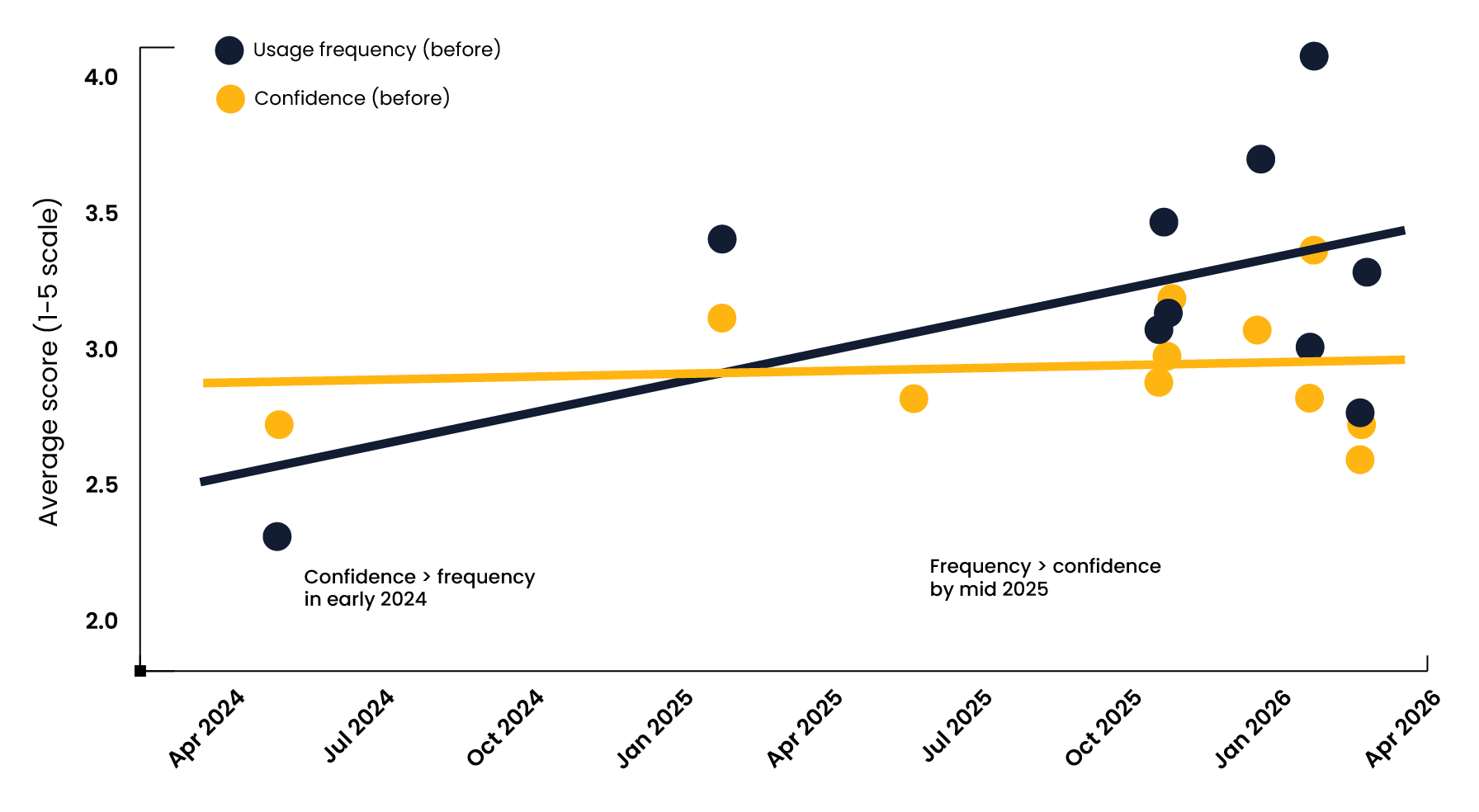
When we started these workshops in April 2024 - just one year after ChatGPT had been released - confidence among the attendees was actually higher than usage frequency. People felt more capable than active (and the rollout of Copilot or other tools to corporate teams was slow, so there was probably an access issue too).
By late 2025, that had completely flipped. Teams are now using AI more than they feel confident doing so, with the gap reaching +0.7 in some companies.
The good news: practical intervention works
In every workshop we’ve run, we see a consistent lift of about 1 point (on a 5-point scale) across all three metrics. Understanding, confidence, and intended usage frequency all move in a single session. Confidence is built by doing - and ideally by doing it somewhere you’re allowed to experiment, make mistakes, and have a bit of fun with it.
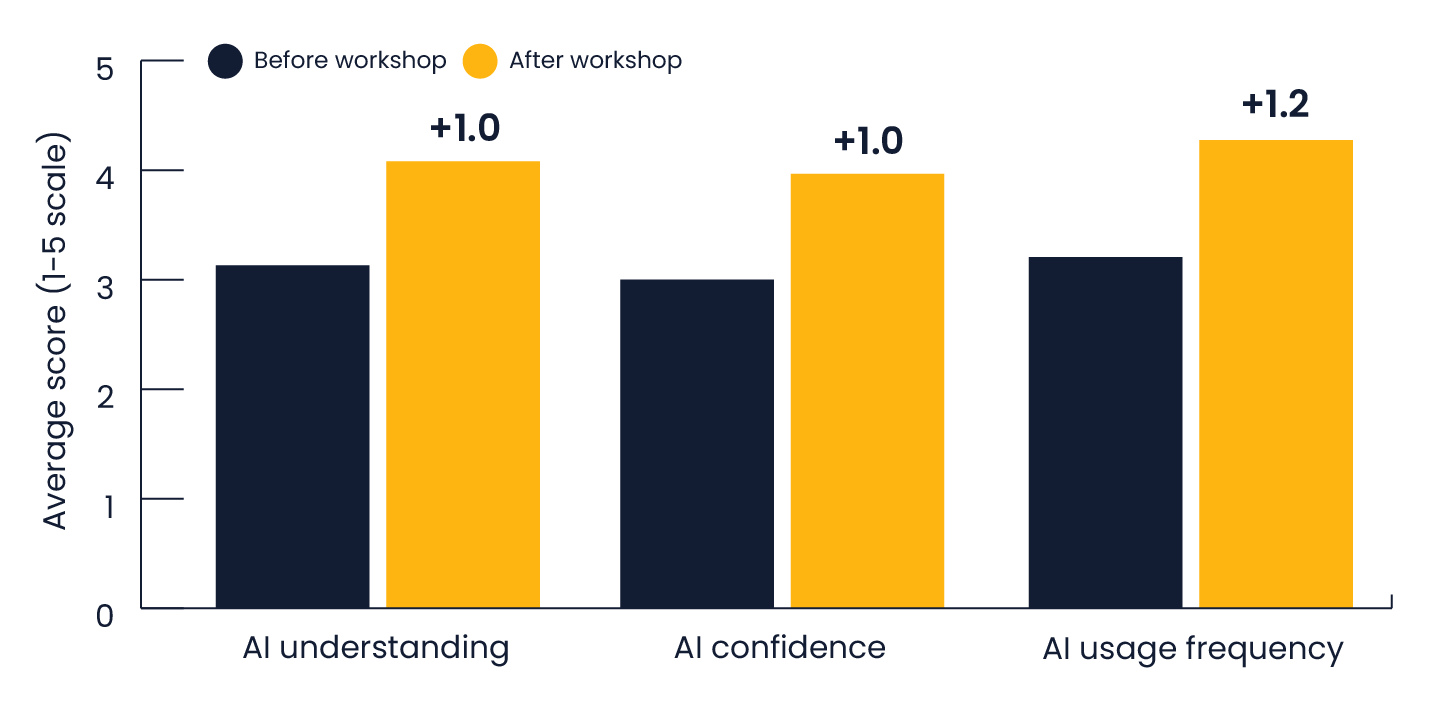
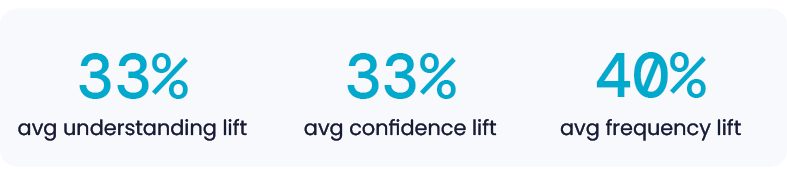
This lift holds regardless of company size, therapeutic area, or how experienced the team is with AI. Whether it’s a global medical affairs team or a local marketing group, the pattern is the same: they just haven’t had practical, hands-on guidance on using AI in a pharma context.
What this means for you
The mandate to use AI is outpacing the support to use it well. Teams aren’t resistant - they’re already doing it. But without practical, pharma-specific guidance, they’re building on shaky foundations. The gap between usage and confidence will only widen as AI tools get better and more embedded in daily work.
In our workshops we frame good AI application around three things: efficiency, value, and innovation. Efficiency is where most teams start - doing existing tasks faster. Value is where the real gains are - using AI to do things better, with more insight and less guesswork. Innovation is further out - using AI to do things that weren’t possible before. Most pharma teams we meet are stuck on efficiency. They’re saving time on first drafts and summaries, but they’re not confident enough to push beyond that. And that confidence gap is what keeps AI as a “nice to have” rather than something that actually changes how a team works.
The companies closing this gap are the ones investing in hands-on training, peer learning, and real-world case studies from other pharma teams. Not theory. Not vendor pitches. Practical insight from people who’ve actually done it.
Close the AI confidence gap in your team. Explore how hands-on, pharma-specific training can turn AI from a 'nice to have' into a real performance driver.


















.jpg)
.jpg)
.jpg)